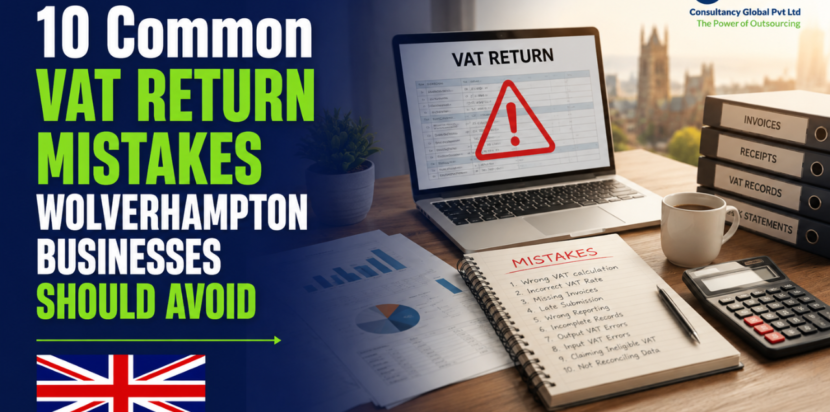
Submitting a VAT return may seem straightforward, but small mistakes can create unnecessary problems for a business. Incorrect VAT calculations, missing records, late submissions or errors in VAT treatment can all affect your VAT position and may require corrections later.
For sole traders, limited companies, partnerships, e-commerce sellers and growing businesses, staying on top of VAT can become increasingly difficult as transactions increase.
This guide explains 10 common VAT return mistakes Wolverhampton businesses should avoid, along with practical steps to help keep VAT records accurate and submissions properly organised.
Whether you manage your VAT in-house or work with a VAT accountant, understanding these common issues can help you improve your VAT compliance process.
1. Missing the VAT Registration Threshold
One of the first mistakes businesses make happens before the VAT return itself.
A business must monitor its taxable turnover and understand when VAT registration becomes compulsory. Currently, businesses generally need to register for VAT if their taxable turnover for the previous 12 months exceeds £90,000, or if they expect taxable turnover to exceed £90,000 in the next 30 days. Voluntary VAT registration may also be possible below this threshold.
Why this can cause problems
Businesses sometimes look only at their annual turnover at the end of the financial year. However, the VAT registration test can involve reviewing taxable turnover over a rolling 12-month period.
If your business is growing quickly, it is important to review turnover regularly rather than waiting until the end of the year.
What to do instead
Keep an eye on your taxable turnover and review whether VAT registration may become necessary as your business grows.
If you are unsure whether your Wolverhampton business needs to register, professional VAT advice can help you understand your obligations based on your individual circumstances.
2. Using the Wrong VAT Rate
Applying the wrong VAT rate is one of the most common VAT accounting mistakes.
Depending on the supply, VAT treatment may differ. Businesses may need to consider whether a transaction is:
- Standard-rated
- Reduced-rated
- Zero-rated
- Exempt
- Outside the scope of VAT
The correct treatment depends on the goods or services involved and the specific circumstances of the transaction.
Why this mistake matters
Using the wrong VAT code can affect:
- The VAT charged to customers
- Input VAT recovery
- Your VAT liability
- The accuracy of your VAT return
This issue can become more complicated for businesses selling different products or services, trading internationally or dealing with special VAT rules.
How to reduce the risk
Review your VAT codes regularly and make sure your bookkeeping system is set up correctly. If a transaction is unusual or unclear, it may be worth checking the relevant HMRC guidance or seeking professional VAT advice before submitting the return.
3. Claiming Input VAT Without the Right Supporting Records
Input VAT is the VAT a business may be able to recover on eligible business purchases.
However, claiming VAT without appropriate records or supporting documentation can create problems later.
Examples of records that may be relevant include:
- VAT invoices
- Purchase invoices
- Supplier documentation
- Receipts
- Import documentation where applicable
HMRC guidance on correcting VAT records also makes clear that supporting documentation can be important when claiming input tax.
A common mistake
A business may see a payment leaving its bank account and assume that the VAT can automatically be reclaimed.
However, a bank transaction alone does not always provide enough information to support the VAT treatment of a purchase.
Better approach
Keep your purchase records organised throughout the VAT period rather than trying to find documents shortly before the filing deadline.
This can also make VAT reconciliation easier and help identify missing invoices before the VAT return is prepared.
4. Failing to Reconcile Sales and Purchase Records
A VAT return should not simply be prepared by looking at a few figures at the end of the quarter.
One of the most important steps is reconciling the underlying business records.
This may involve checking:
- Sales invoices
- Purchase invoices
- Bank transactions
- Credit notes
- Accounting software reports
- VAT control accounts
- E-commerce platform reports
Why reconciliation matters
Without proper reconciliation, businesses may:
- Miss transactions
- Duplicate entries
- Apply incorrect VAT codes
- Claim VAT twice
- Omit sales from the return
A mismatch between your bookkeeping records and your actual transactions can result in inaccurate VAT figures.
For businesses with a high number of transactions, regular reconciliation can make the VAT return process much easier.
5. Waiting Until the Last Minute to Prepare the VAT Return
Leaving VAT preparation until the filing deadline creates unnecessary pressure.
When records are incomplete, rushed preparation can increase the risk of errors.
For many businesses, the deadline for submitting the VAT Return and paying HMRC is usually one calendar month and seven days after the end of the accounting period, although businesses should always check the deadline that applies to their own VAT arrangements.
Problems caused by last-minute filing
Waiting until the deadline can mean:
- Missing invoices are not identified in time
- VAT errors go unnoticed
- Bank transactions remain unreconciled
- Software access issues cause delays
- There is little time to review the completed return
A better process
Try to keep VAT records updated throughout the quarter.
A regular monthly review of sales, purchases and VAT records can reduce the workload when it is time to prepare and submit the return.
6. Not Following Making Tax Digital Requirements
Making Tax Digital has changed how VAT-registered businesses manage their VAT records and submissions.
Businesses within the scope of Making Tax Digital for VAT are required to follow the applicable digital record-keeping and filing requirements. HMRC’s VAT legislation sets out the records that must be kept digitally and the requirements surrounding digital VAT records.
Common MTD mistakes include:
- Using unsuitable or non-compliant processes
- Manually transferring figures without checking digital record requirements
- Keeping incomplete VAT records
- Failing to review how software is connected to the filing process
- Assuming that bookkeeping software automatically makes every VAT process compliant
How to avoid MTD problems
Use appropriate software and make sure your VAT record-keeping process is reviewed regularly.
The important point is not simply having accounting software. Your overall process should support accurate digital records and VAT reporting.
For businesses that are unsure about their current setup, a review from an experienced VAT specialist can help identify potential issues before the next VAT return is submitted.
7. Choosing or Using the Wrong VAT Accounting Scheme
The VAT scheme used by your business can affect how and when VAT is accounted for.
Depending on eligibility and circumstances, businesses may consider options such as:
- Standard VAT accounting
- Flat Rate Scheme
- Cash Accounting Scheme
- Annual Accounting Scheme
These schemes have different eligibility requirements and operating rules. For example, HMRC publishes turnover thresholds for joining and leaving certain VAT accounting schemes.
Why this mistake is important
A VAT scheme that worked well when your business was smaller may no longer be the most suitable option as your circumstances change.
Business growth, transaction volume, industry requirements and changes in turnover can all affect whether your current approach remains appropriate.
What businesses should do
Review your VAT scheme periodically, particularly if your turnover or business model has changed significantly.
Professional VAT advice can help you understand which options may be relevant, although the right approach will depend on your individual circumstances.
8. Ignoring VAT Errors After They Are Discovered
Finding a mistake after submitting a VAT return can be worrying, but ignoring the issue is usually not the answer.
HMRC allows certain qualifying VAT return errors from the previous four years to be corrected through a later return, depending on the size and nature of the net error. Larger errors, certain errors exceeding the applicable limits, and deliberate errors must be notified to HMRC separately.
Why businesses should act promptly
Keeping a clear record of the error can help establish:
- When it was discovered
- Which VAT period was affected
- How the mistake occurred
- The amount involved
- Whether it relates to input VAT or output VAT
The correct method of correction depends on the circumstances and value of the error.
If you discover a significant or complicated VAT mistake, seeking professional advice before making an adjustment can help you understand the appropriate next step.
9. Forgetting About VAT on E-Commerce, Imports or Cross-Border Transactions
VAT can become more complicated when a business sells through online marketplaces or deals with international transactions.
Wolverhampton businesses involved in e-commerce or cross-border trade may need to consider VAT issues relating to:
- Online marketplaces
- Import VAT
- Export transactions
- Overseas customers
- Reverse charge arrangements
- Postponed VAT accounting, where applicable
Why this creates risk
These transactions may not always follow the same VAT treatment as ordinary UK sales or purchases.
Using the same VAT code for every transaction without reviewing the underlying supply can lead to incorrect reporting.
Businesses using platforms such as Amazon, eBay or Shopify should ensure that sales reports and transaction data are reviewed carefully before VAT figures are finalised.
10. Trying to Manage Complex VAT Requirements Without Professional Support
Many businesses can manage straightforward VAT returns successfully.
However, as a business grows, VAT can become more complex.
This is particularly true when dealing with:
- Multiple VAT rates
- Large transaction volumes
- E-commerce sales
- Imports and exports
- Reverse charge transactions
- VAT scheme changes
- VAT corrections
- HMRC queries
- Complex input VAT claims
Trying to manage a complicated VAT position without enough time, knowledge or support can increase the risk of errors.
When professional VAT support may help
A VAT accountant or specialist can help with areas such as:
- VAT return preparation
- VAT reconciliation
- Reviewing VAT records
- HMRC-compliant filing processes
- VAT registration
- Making Tax Digital support
- VAT scheme guidance
- Error identification and correction
- Ongoing VAT compliance support
For businesses looking for professional assistance, our VAT Return Services in Wolverhampton provide support with preparing, reviewing and managing VAT returns based on your business requirements.
A Simple VAT Return Checklist for Wolverhampton Businesses
Before submitting your next VAT return, take a moment to check:
Sales
- Are all sales included?
- Have the correct VAT rates been applied?
- Have credit notes been accounted for?
Purchases
- Do you have the necessary supporting records?
- Have eligible purchases been included correctly?
- Have VAT codes been checked?
Records
- Are bank transactions reconciled?
- Are VAT records up to date?
- Have unusual transactions been reviewed?
Compliance
- Are your digital record-keeping processes appropriate for your VAT obligations?
- Is your VAT return being prepared using the correct figures?
- Have you checked the deadline that applies to your business?
Final Review
Before submission, review the figures and investigate anything that looks unusual.
A few extra minutes spent checking the return can be valuable, particularly when a business has experienced changes in sales, expenses or trading activity during the VAT period.
Why Accurate VAT Returns Matter for Growing Businesses
Accurate VAT filing is about more than simply submitting a return before the deadline.
A well-managed VAT process can help businesses:
- Maintain clearer financial records
- Identify errors earlier
- Improve bookkeeping processes
- Prepare for future growth
- Reduce the need for avoidable corrections
- Keep VAT information organised throughout the year
As a business grows, having a structured process for VAT preparation and record keeping becomes increasingly important.
This is particularly relevant for growing sole traders, limited companies, partnerships and e-commerce businesses where the number and complexity of transactions can increase over time.
Get Professional Help with VAT Returns in Wolverhampton
VAT mistakes are often caused by rushed preparation, incomplete records or uncertainty about the correct VAT treatment.
The best approach is to keep accurate records throughout the VAT period and review your figures before submission.
At Rudra Consultancy Services, we provide professional support for businesses that need help with VAT preparation, reconciliation, filing and ongoing VAT compliance.
If you are looking for a VAT accountant in Wolverhampton, need help with VAT returns, or want support with your VAT record-keeping and Making Tax Digital processes, our team can help you understand and manage your VAT responsibilities.
Explore our VAT Return Services in Wolverhampton to learn more about how we can support your business.
FAQs About VAT Return Mistakes
What is the most common VAT return mistake?
Common mistakes include applying the wrong VAT treatment, missing transactions, claiming input VAT without appropriate supporting records, failing to reconcile accounts and submitting incorrect figures because the return was prepared too quickly.
Can I correct a mistake on a VAT return that has already been submitted?
In some circumstances, yes. HMRC allows qualifying net errors from previous VAT returns to be corrected through a later return, subject to applicable limits and conditions. Larger, deliberate or otherwise qualifying errors may need to be reported separately.
How often do businesses submit VAT returns?
Many businesses submit VAT returns quarterly, but the accounting period and filing arrangements can vary depending on the business and VAT scheme.
What happens if I submit my VAT return late?
HMRC operates a points-based late submission system for VAT returns. Repeated late submissions can lead to a financial penalty once the relevant points threshold is reached, and late payment can also result in penalties and interest.
Do Wolverhampton businesses need Making Tax Digital software for VAT?
VAT-registered businesses need to follow the Making Tax Digital for VAT requirements that apply to them, including the relevant digital record-keeping and filing obligations.